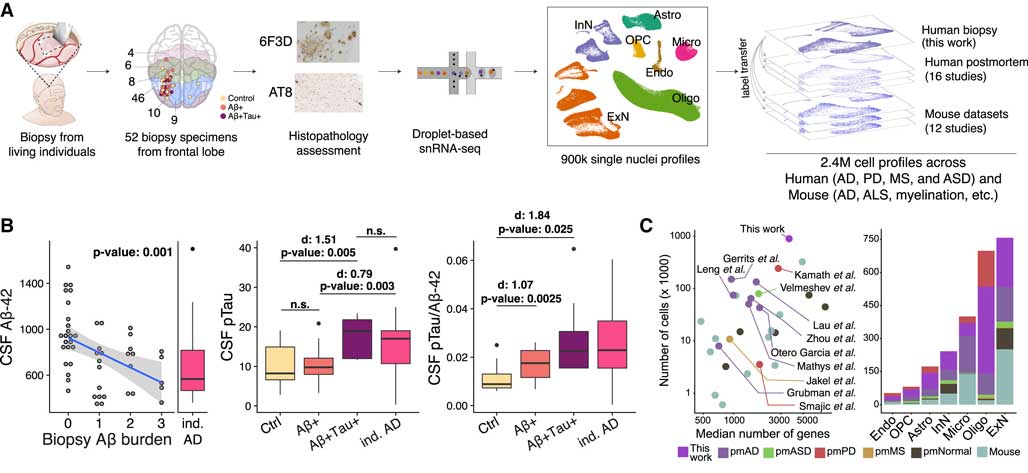
I proudly present here our recently published work with the group of Evan Macosko at the Broad Institute of MIT and Harvard, Cambridge.
Early Alzheimer’s disease pathology in human cortex involves transient cell states. #Alzheimers, #alzheimersdisease, #electrophysiology, #MEA, #dataanalysis, #alzheimersawareness, #dementia, #EndAlz
https://lnkd.in/dtzfaVWa
https://lnkd.in/d46U-ymb
The input and output information flow in the cortical circuit is tightly regulated. Thalamic sensory information targeting layer 4 of the cortex engages layer 2-3 mechanisms and in turn layer 5-6 circuitry in order to ensure that processing of incoming information with high temporal structure would elicit appropriate feedback modulation of the incoming events back to the thalamus structure. The balance of this information flow is critical as it preserves both the temporal and the spectral characteristics of brain dynamics and facilitates the encoding and fine tuning of incoming information via feedforward and feedback gain modulation.
Using my developed method of recording electrical activity from small neurosurgical samples extracted from idiopathic normal pressure hydrocephalus patients, we show that layer 2-3 circuitry in human cortex exhibits a hyperexcitable phenotype that disrupts the balance of feedforward modulation to the deep layers of the circuitry. Our data argue that early hyperexcitability in the superficial layers of human cortex in AD related pathophysiology is not followed by commensurate increases in the output of the circuitry leading to a potentially persistent overload of intracortical information and lack of appropriate gain modulation.
https://www.cell.com/cell/fulltext/S0092-8674(23)00859-0