Neural circuits #neuralnetworks are indeed complex entities that are difficult to predict and comprehend, even for experienced and dedicated neuroscientists. This complexity arises from the intricate interplay of numerous components and processes, including synaptic interactions, ionic conductances, and internal cellular mechanisms, all of which can exhibit highly dynamic and non-linear behavior.
To understand how a neural circuit works, one must first comprehend how individual elements interact. Computer modeling of biologically inspired neurons #neurons, with random fluctuating excitatory and inhibitory synapses and internal calcium operating mechanisms, provides an excellent solution for gaining deeper insights into neural circuitry operations for both the novice and the experienced alike! This includes crucial computations of neuronal elements such as action potential firing, bursting propensity, irregularity, and depolarization block.
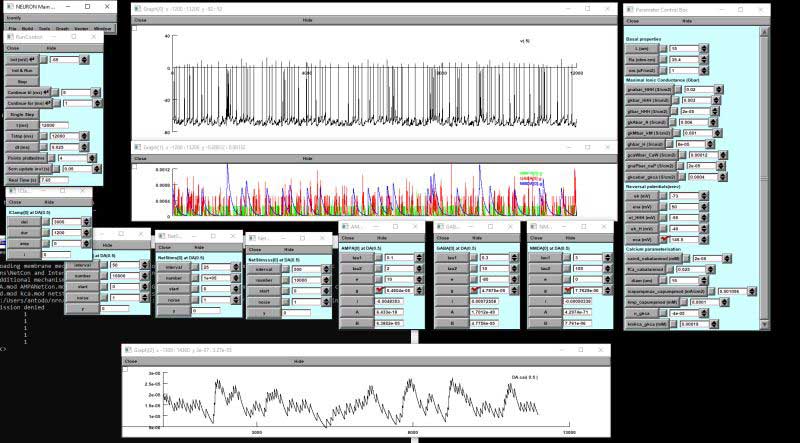
In this context, I present an extended, unpublished model of a brainstem #dopamine neuron that are important in sleep regulation #sleep. This model builds upon my previously published work and experimental research, demonstrating the interplay of ionic conductances and synaptic activation on the computational output of dopamine neurons. The model includes parameter boxes that allow users to modify properties on the fly and rerun simulations to observe the results. Additionally, data-saving functionalities are implemented, offering flexibility for extending outputs as needed.
Freely available for download from my GitHub under a GNU licence. Runs on NEURON environment using precompiled .mod files in C! Have fun learning and simulating!